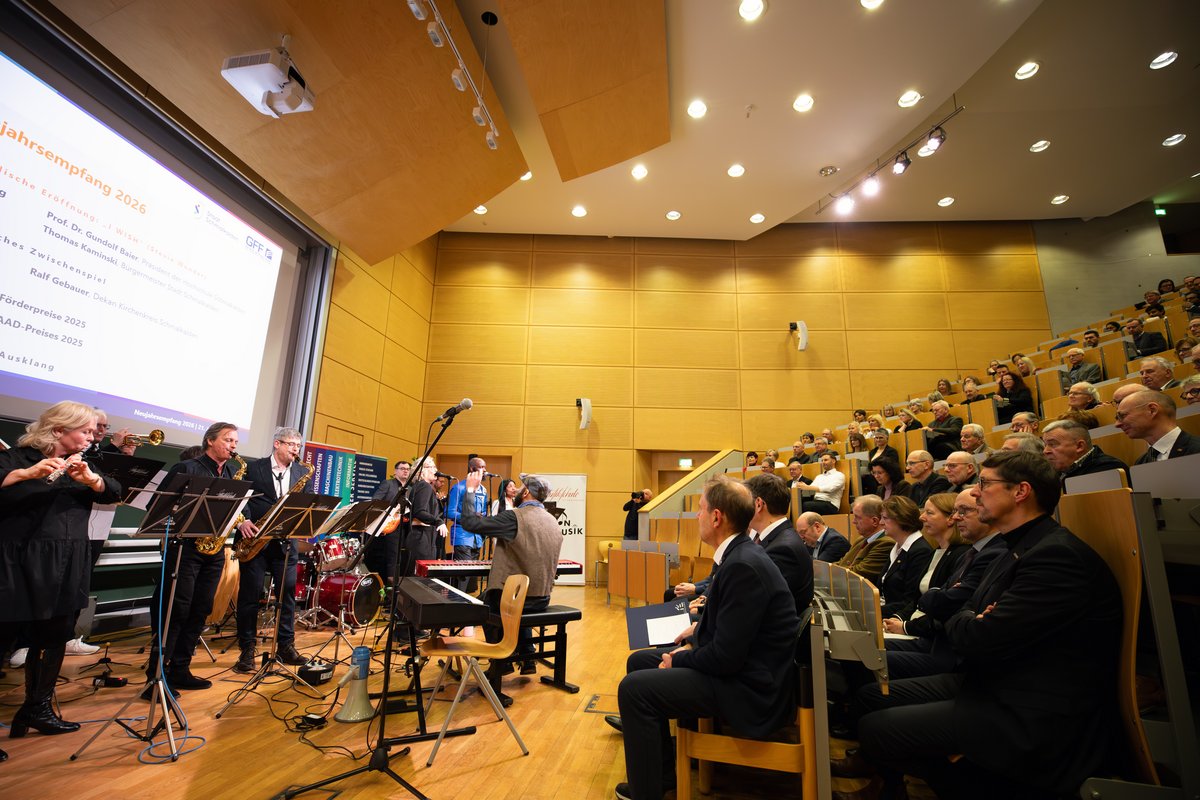
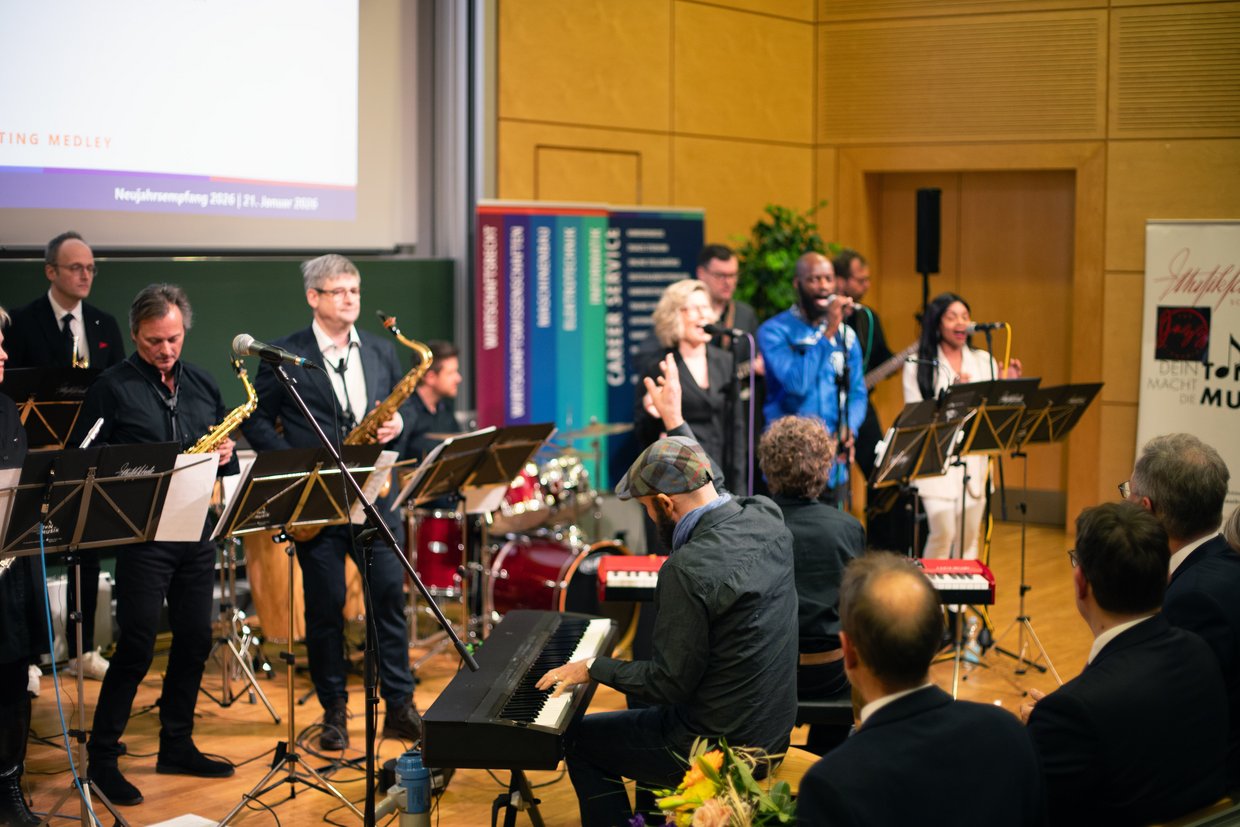
The Audimax was packed yesterday for the university’s annual New Year’s reception, jointly hosted by Schmalkalden University of Applied Sciences, the University Support Association, and the City of Schmalkalden. In addition to numerous guests from politics and public administration, more than 60 company representatives attended—more than ever before.
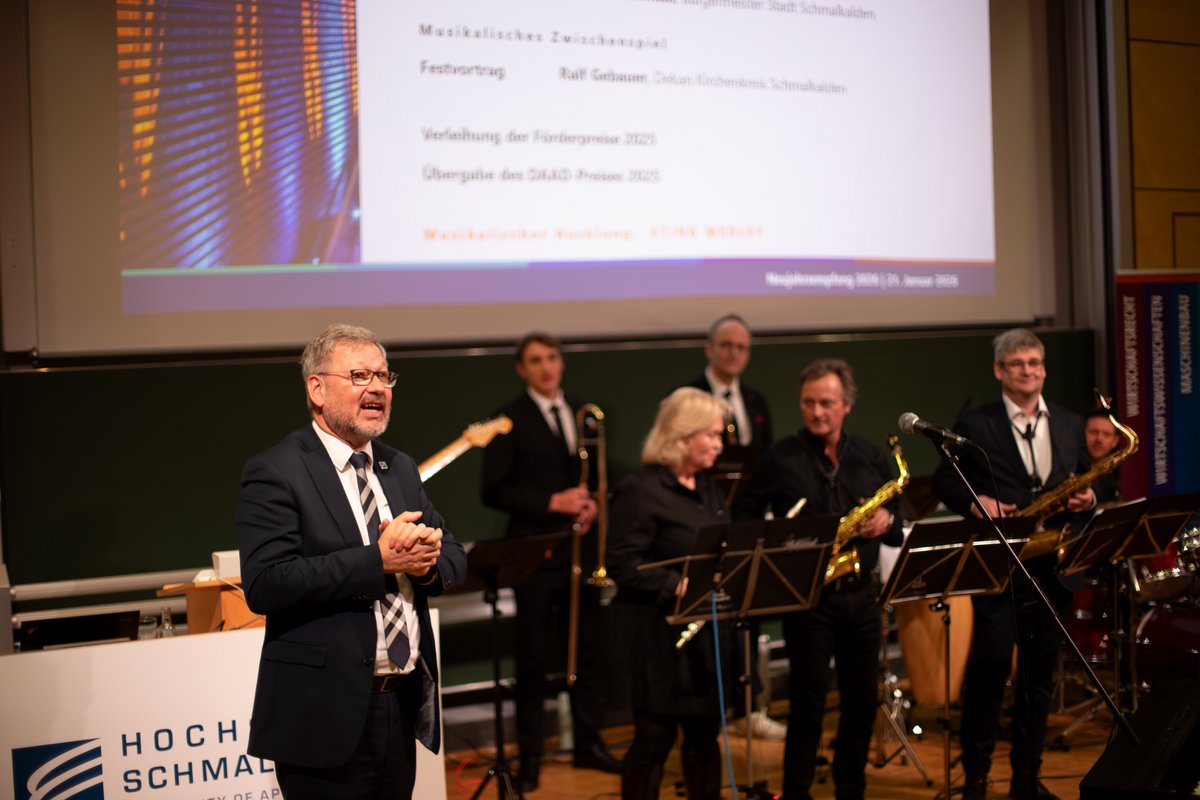
Transformation, change, and processes of transition were the key themes addressed by the speakers. Leading the program was University President Prof. Gundolf Baier, who traditionally opened the New Year’s reception. “We are in a period of transition. At all levels, processes of change are taking place,” said Baier, emphasizing that universities, too, must adapt. Looking back on the past year, he expressed great satisfaction: “We have fully fulfilled our mission.” The WORT project was completed last year, and Baier noted that the university had taken the right steps. A follow-up project is now underway to achieve all remaining goals. He also expressed pride in the student numbers, which currently stand at 2,942: “For four consecutive years, student numbers have developed positively—no other university in Thuringia can claim that.” From a higher education policy perspective, major challenges lie ahead this year, particularly Framework Agreement VI, which he described as likely to be the most important agreement in decades.
A Hopelessly Optimistic Mayor
Mayor Thomas Kaminski said he is looking forward to the new year despite the many challenges facing the city. He, too, was satisfied with the past year: “We invested €21.5 million and balanced the deficit.” The city continues to invest and is focusing on development, such as expanding the industrial area along the B 19. “We are creating the conditions that allow people to stay here,” Kaminski said. Doing nothing is not an option for him: “We must invest, otherwise rural areas will die.” Overall, the city has achieved almost all of its goals, thanks to strong economic performance and the work of a committed administration. Kaminski stressed the importance of focusing on problems while also recognizing opportunities: “We can’t solve all problems, but we must also see opportunities and not just risks.” He described himself as “hopelessly optimistic,” in line with the title of a current nonfiction book he is reading.
From Reforms to Transformation
In his keynote address, Dean Ralf Gebauer spoke about the path from reforms to transformations. The Schmalkalden church district is also facing structural changes, he said, with the greatest challenge being a “mental change.” “We need to think in networks, come together, and leave well-trodden paths,” Gebauer emphasized. The concept of the participatory church (Mitmachkirche) represents the future: as a project of the Schmalkalden church district, it actively involves people in shaping church life.
Awards for Outstanding Final Theses
Another highlight of the evening was the presentation of the sponsorship awards. Dominik Leuwer and Frank Eberhardt received the VDWF Award for their master’s theses. Dominik Leuwer wrote his thesis on “Measurement system analysis for computed tomography for the geometric determination of plastic components” under the supervision of Prof. Stefan Roth at the Faculty of Mechanical Engineering. It was graded 1.0 and provides a basis for future analyses of plastic component geometries. Frank Eberhardt wrote his thesis on “Investigation of rheological effects in the gate area of the soft component in thermoplastic multi-component injection molding,” supervised by Dr. Marco Müller and graded 1.3.
Another sponsorship award was presented by the City of Schmalkalden to Jayadeep Raj for his thesis “Harnessing the potential of generative AI tools in the design and prototyping paradigm of exoskeleton arms.” The thesis was supervised by Prof. Frank Schrödel and graded 1.7.
The Friends and Supporters of Schmalkalden University of Applied Sciences Award was presented to Anika Lintz for her thesis “Online meetings are no longer uncharted territory – An empirical study of video conferencing fatigue.” Supervised by Prof. Lenka Ďuranová, the thesis received a grade of 1.0.
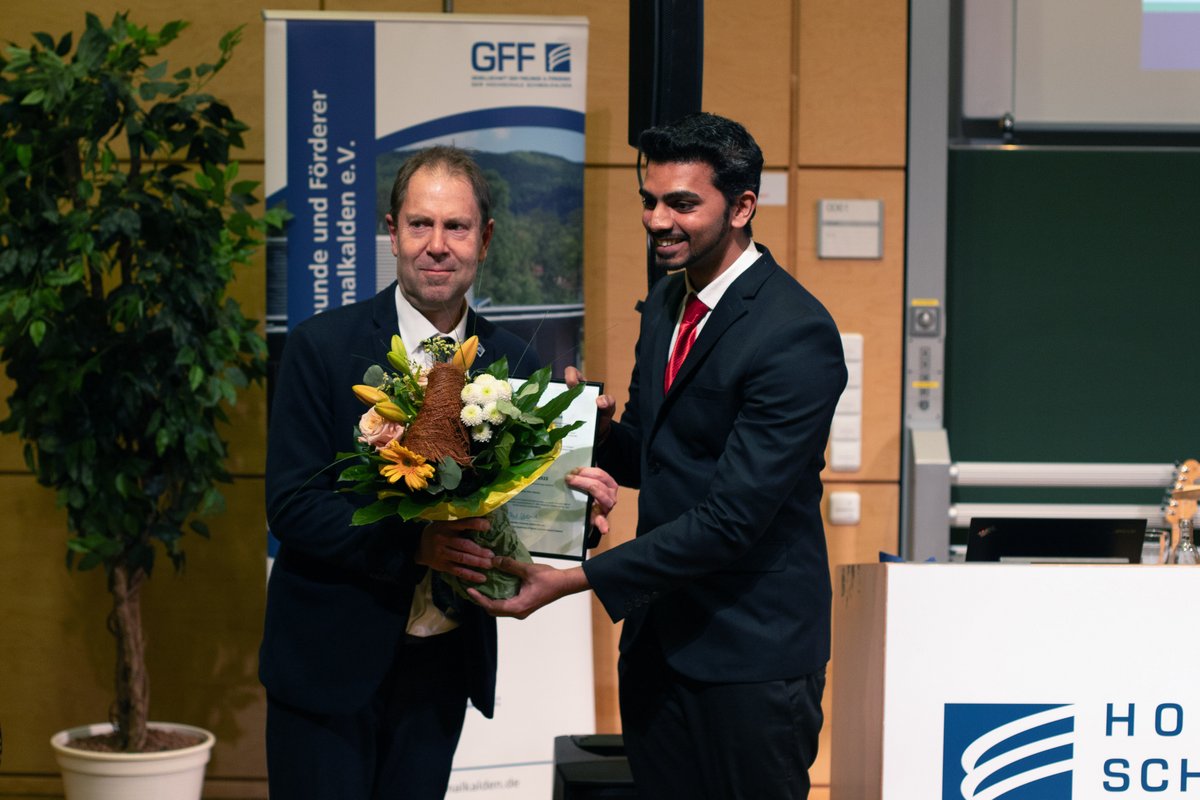
Abhishek Uttam Salunke from India received the DAAD Prize 2025, presented by Prof. Uwe Hettler. He is enrolled in the master’s program Mechatronics and Robotics and was honored for his strong academic performance and his positive engagement far beyond his studies.
The final honor of the evening was bestowed upon Vice President Prof. Uwe Hettler, who was ceremonially bid farewell by the Executive Board after 12 years as Vice President for Studies and International Affairs, receiving a photo collage and a wine voucher. His successor is Prof. Carsten Behn from the Faculty of Mechanical Engineering.
The New Year’s reception was accompanied musically by the Jazz-O-Phonics.