
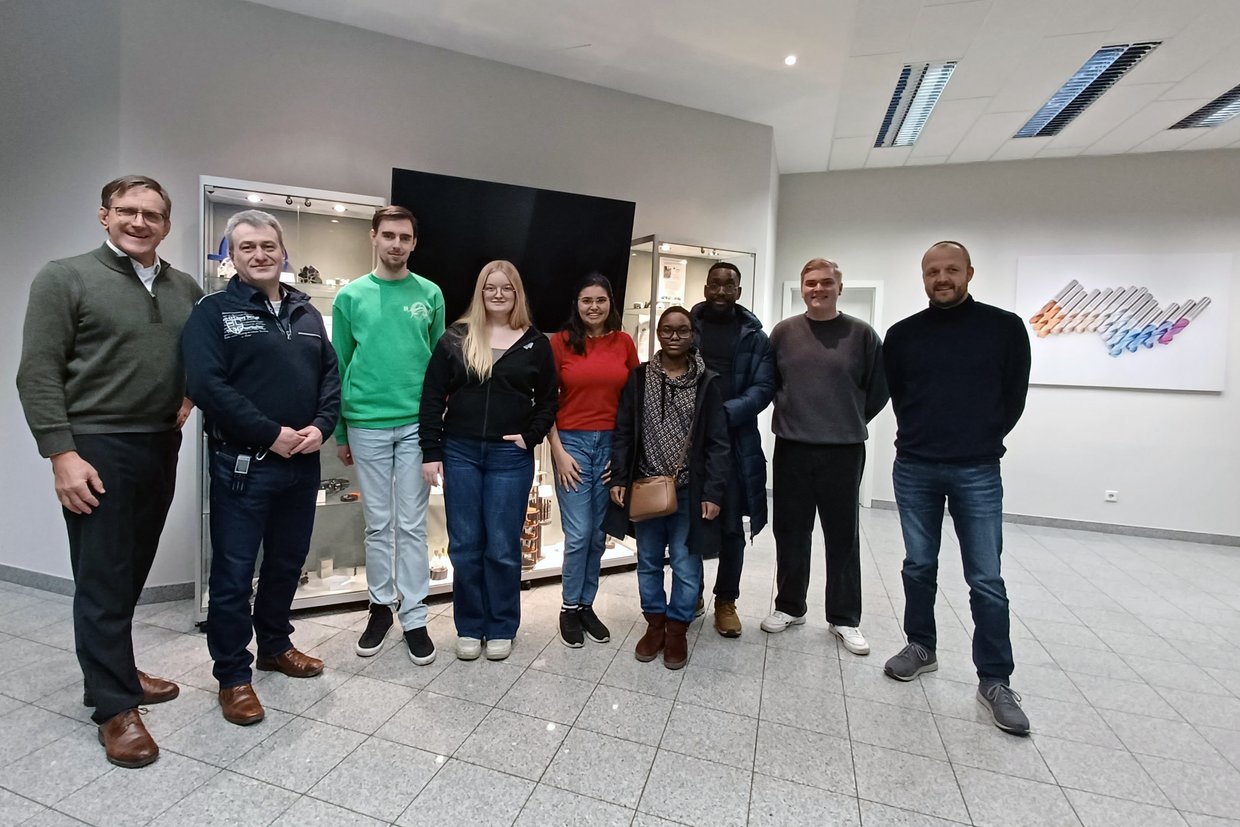
“We see ourselves as a highly specialized supplier of tools in order-oriented small series production,” said Jens Neumann, describing the unique DNA of GFE Präzisionstechnik Schmalkalden GmbH. At the beginning of the year, the managing director welcomed students from the Faculty of Economics and their professor Michael Dornieden to the company during their visit. Located in Näherstiller Straße, in the immediate vicinity of the university, the company specializes in the development and manufacture of high-precision tools for customers in the optical industry and toolmaking, for example. With just under 70 employees, it achieved a turnover of three million euros in 2025, operating in two shifts.
"What sets us apart from comparable companies in the supplier sector in our research partnership with Schmalkalden University of Applied Sciences is our complementary range of industry-oriented development services. This enables us to produce drilling or cutting tools that are specifically tailored to individual customer requirements, even if these are unique worldwide. We don't want to be a pure contract manufacturer," added Martin Voigt, the company's second managing director.
During the subsequent tour of the company, the students focused in particular on the extent to which lean production methods and tools are used. They learned about the special logistical and production-related conditions of high-mix, low-volume small-batch production, which is characterized by lead times of several weeks, strict quality controls, and comparatively high machine setup costs. Without state-of-the-art machinery consisting of CNC machining centers, precision measuring equipment, grinding and coating systems, and skilled labor, the extreme quality requirements of customers would be impossible to meet, according to Neumann. A realistic goal here is a complaint rate of less than one percent for manufacturing orders. In addition, customers from the tool sector, some of whom have been with the company for many years, appreciate GFE's exceptional delivery flexibility and reliability as a high-performance A-supplier.
Neumann sees a particular area of application for increasing plant efficiency in the use of lightweight robots for parts handling in machining and cutting processes. Significant, application-oriented advances have already been made at the workshop level, which could potentially be used in the future to set up a third shift without machine operators, for example. The group of visitors from the university was able to profitably deepen their technical knowledge of modern production processes on this day.