Last week, the fifth annual E-Science Day took place at Schmalkalden University of Applied Sciences. The event was hosted by the Department of Electrical Engineering to give students and guests insights into ongoing research activities.
Professors and students from the Department of Electrical Engineering and our partner university, LIK Kaunas, presented their current research projects. For example, Professor Maria Schweigel discussed her research project BauKIRo—“Automated Monitoring of Construction Progress Using Artificial Intelligence and Robotics.” Together with FAU Erlangen-Nuremberg, she is developing an autonomous aerial robot whose images of the building’s interior can be used for the automatic and objective monitoring of construction progress, which the system then evaluates and documents fully automatically using artificial intelligence. In this context, it is necessary to adapt the drones to the specific environment of buildings under construction. Specifically, this involves, for example, the danger posed by cables hanging around. Another problem is the data processing of the images, which can result in erroneous point clouds.
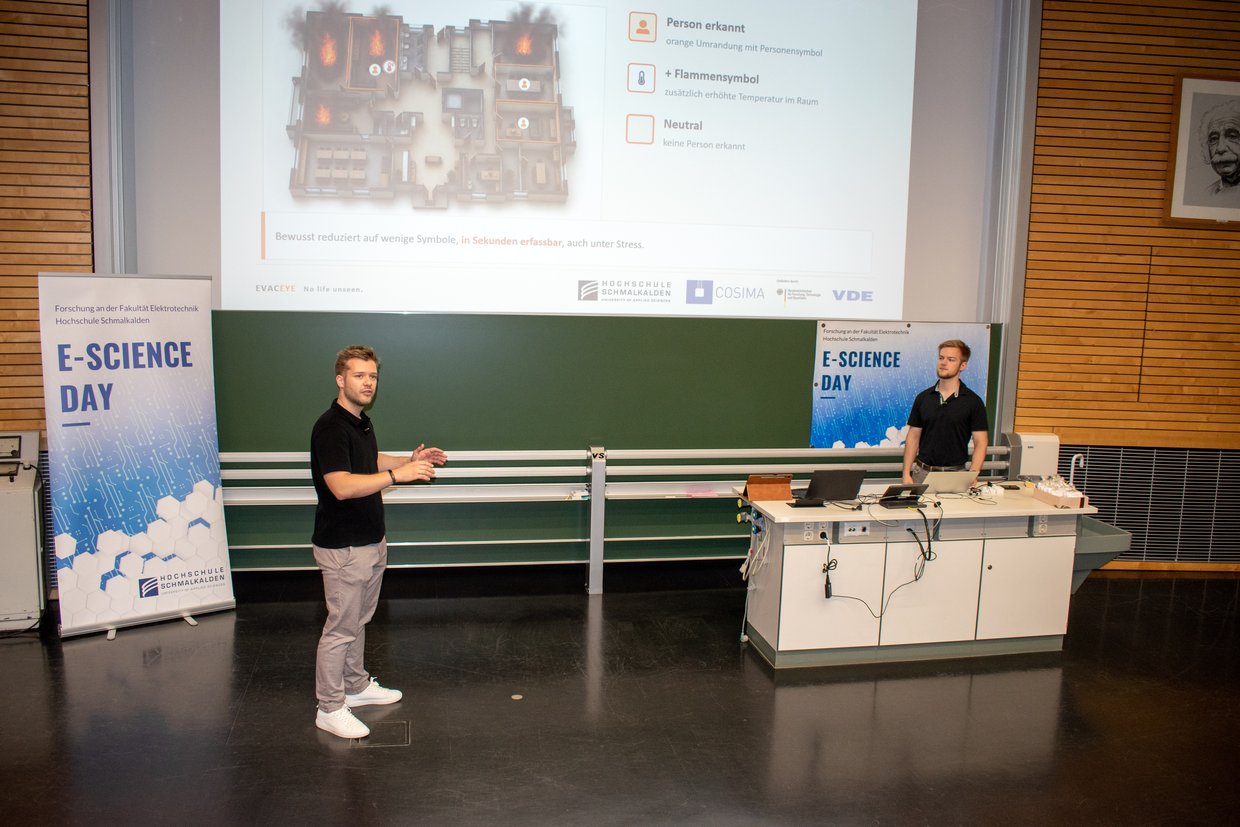
Students Marius Weimann, Leonard Maletzke, Karl Plata, and Luis Marcus are participating in this year’s COSIMA competition with their project “EvacEye.” The goal of the competition is to identify new applications for sensors and microsystems. In particular, the competition seeks applications that improve and facilitate the interaction between people and technology in a wide variety of areas of daily life. The four electrical engineering students have taken on this challenge. Specifically, the project aims to locate people who are still inside a building in the event of a fire. “EvacEye processes radar and thermal data directly at the sensor and provides clear status information—exactly what matters in a real-world emergency. Under normal conditions, the system monitors itself in the background—only when a fire alarm is triggered does it switch to full operation and provide an overview of the situation,” the students report. Each room is monitored by an independent sensor node. Processing occurs in multiple stages—from raw sensor data acquisition to clear status information on the situation overview. “We hope to save more lives with this system,” says Leonard Maletzke.
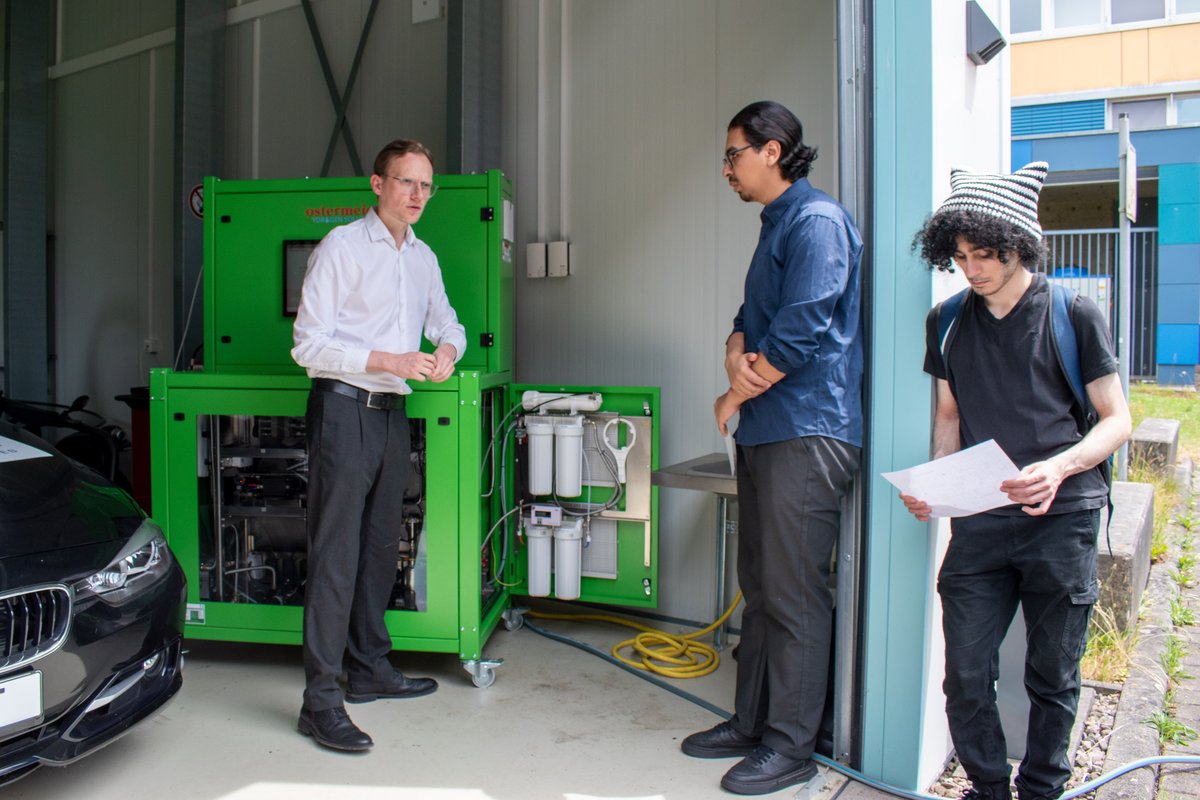
Prof. Martin Schreivogel presented a new hydrogen battery demonstration system: The system, developed by ostermeier H2ydrogen Solutions, replicates all the functions of a large-scale hydrogen battery plant, from hydrogen production to reconversion into electricity. It consists of several key components: an electrolyzer for converting electrical energy into hydrogen, a fuel cell for reconverting stored hydrogen into electricity, and a hydrogen tank for storage. In addition, the system features a battery as an additional power storage device, a control system for operation, and an interface for user interaction and real-time monitoring. Important safety features for handling hydrogen and high-voltage components, as well as programming tasks and sample collection, can also be clearly demonstrated and practiced on the system.