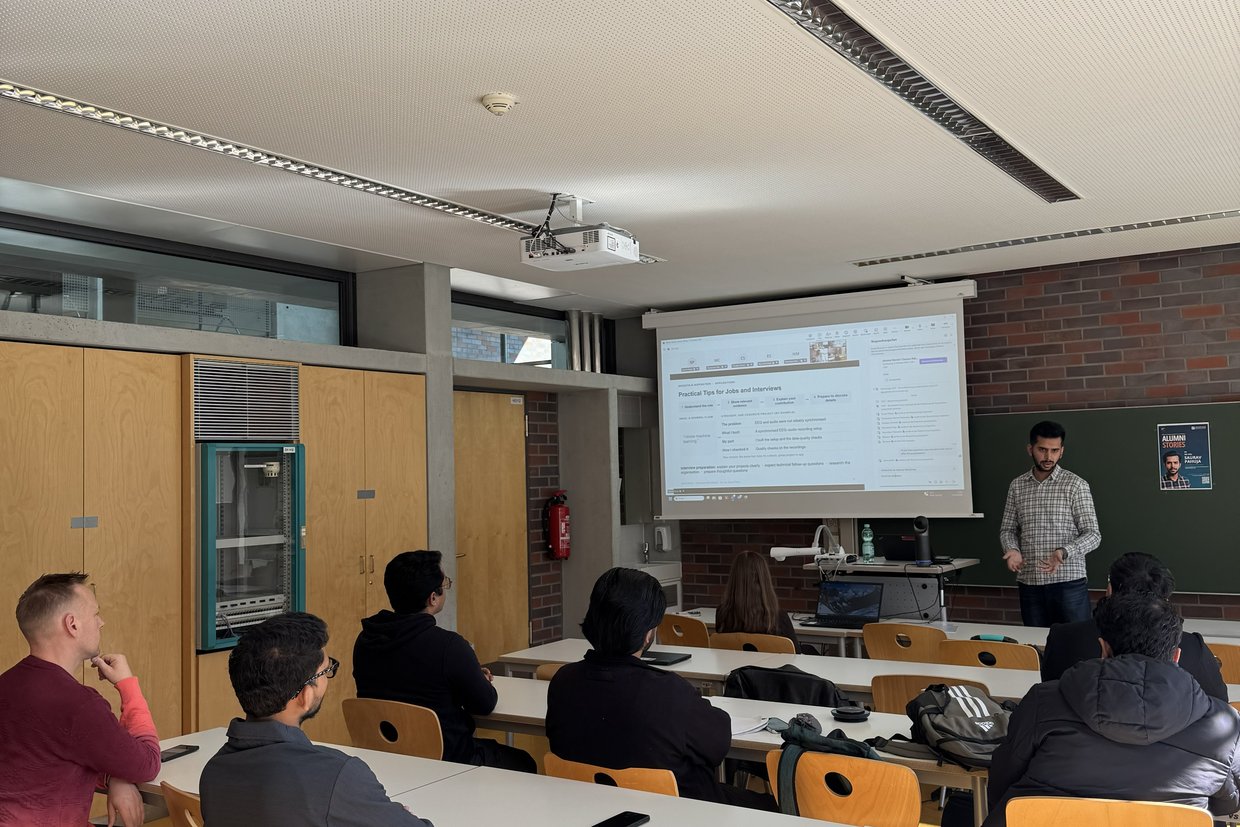
From aspiring software developer to postdoctoral researcher in AI: on 15 October 2026, Dr.-Ing. Saurav Pahuja shared his path into academic research with international students as part of the “Alumni Stories” series. The series is organised by the ProTELC project together with the International Career Service and WORTPlus.
Saurav Pahuja completed the Master’s programme in Applied Computer Science at Schmalkalden University of Applied Sciences in 2022. Today he conducts research at the Cognitive Systems Lab of the University of Bremen, working where artificial intelligence meets neurotechnology. When he arrived in Schmalkalden from India in 2019, neither research nor a doctorate was part of his plans. In his talk, he traced how this changed over the course of his studies.
The decisive impulse came from a student assistant position in Prof. Martin Golz’s Neuroinformatics group. There, Mr. Pahuja worked with brain signal data (EEG) for the first time and explored how machine learning can be used to predict microsleep at the wheel. While writing his Master’s thesis, he also gained experience in applied research at Fraunhofer IPA. He then joined the University of Bremen as a research associate and completed his doctorate there in 2026. He explained that his choice was driven not by a long-term career plan but by his wish to keep working with AI and brain signals: “You may not know your final destination, but you can choose the next problem you want to work on.” In Bremen, his next research question was how brain signals can reveal which voice a person is following when several people are speaking at once. This could one day lead to new kinds of hearing systems.
Mr. Pahuja also spoke in detail about setbacks. Unreliable recordings, unsuccessful experiments and a rejected funding proposal had at times left him facing real uncertainty. The main lesson he drew from this: “Resilience does not mean repeating the same failed approach. It means understanding what went wrong and adapting.” His persistence paid off. He won second place in an international challenge held as part of IEEE ICASSP, and the German Research Foundation (DFG) approved a research project he designed. Such achievements, however, never happen overnight: “Visible success often follows years of less visible preparation.”
He described Schmalkalden University of Applied Sciences as an important starting point for his career: “I came to Schmalkalden with one plan, and discovered another through experiences that began here.” Close contact with lecturers, the link between teaching and research, and the chance to work on real projects during his studies had given him essential foundations. He encouraged students to approach professors directly and ask about projects, thesis topics or student assistant positions. A student assistant job in particular offers a chance to explore a field without much risk. In applications, he said, a single project that one can explain thoroughly carries more weight than a list of skills. Looking back, he admitted that he would have invested more time in learning German. Although research is largely conducted in English, good German skills are indispensable for a professional future in Germany.
In the discussion that followed, participants were particularly interested in how to enter research and what is required for a doctorate. One point became clear: in Germany, a doctorate is often combined with a regular, salaried position as a research associate. Prior publications are not strictly required; Mr. Pahuja himself had not published before starting his PhD. He also encouraged students to make active use of AI tools in their studies and research, while always checking the results critically. To close, he left the students with a personal motto: “Your will to succeed must be greater than your fear of failure.”
Saurav Pahuja’s visit added a perspective that the “Alumni Stories” had rarely covered: an academic career as an alternative to entering industry. The series brings students together with graduates of Schmalkalden University of Applied Sciences. It offers guidance for their own career planning and supports international students in their transition into the German labour market. More information and further “Alumni Stories” can be found here.