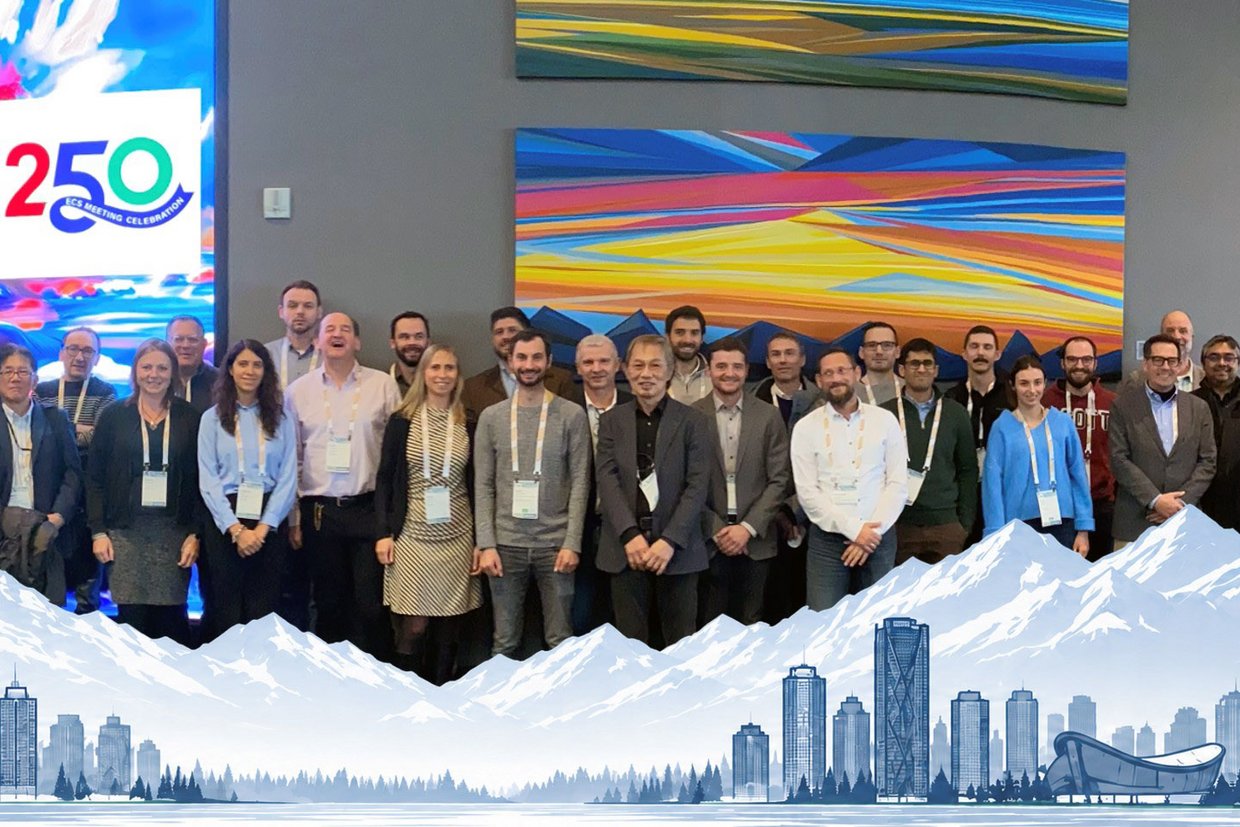
At the end of October, the symposium “Semiconductor Wafer Bonding: Science, Technology, and Applications 18” took place as part of the 250th Meeting of the Electrochemical Society (ECS) in Calgary, Canada. The ECS Meeting is one of the leading international conferences on electrochemistry and solid-state sciences and brings together researchers from academia and industry. It provides an important platform for discussing the latest research findings, assessing technological developments, and fostering international collaboration.
With 38 scientific papers, the Wafer Bonding Symposium offered a high-quality scientific program that ranged from fundamental questions in interfacial physics to new bonding methods and applications in microsystems technology and heterogeneous integration. Schmalkalden University of Applied Sciences was involved in five papers, including those in which its researchers served as co-authors. This made it the third-highest contributor to the symposium and underscored its strong international presence in this field of research.
A particular highlight was Luis Marcus’s receipt of the “Best Student Presentation Award in Bronze.” In his presentation, “Shear Test for Wafer-Bonded Dies – Setup and Evaluation,” he presented the key findings of his bachelor’s thesis, which he completed this year at X-FAB MEMS Foundry Erfurt GmbH. The focus was on the setup and evaluation of a shear test for examining wafer-bonded chips. The award recognizes his scientific work and its compelling presentation to an international audience of experts. The other student awards went to Yokohama National University and CEA-Leti in Grenoble. Overall, the student entries were distinguished by their very high scientific quality. In addition to the award-winning projects, students from the University of California, Los Angeles, the University of Florida, and Tohoku University in Japan, as well as other early-career researchers from CEA-Leti, presented their results. The competition thus also highlighted the broad scope and high standard of early-career research in the field of wafer bonding.
Prof. Roy Knechtel presented two additional papers from Schmalkalden University of Applied Sciences: “Local Atmospheric Plasma Activation for Low-Temperature Wafer Direct Bonding” and “A Fundamental Study on the Potential Use of Eutectic Gold-Silicon Wafer Bonding for Applications in Industrial MEMS Technologies.” In addition, he served as a co-author on the presentations by Sophia Dempwolf (X-FAB), “High-Temperature Semiconductor and Glass Frit Wafer Bonding in One MEMS Inertial Sensor Foundry Process,” and Thomas Weidner, “Investigation and Optimization of Wafer Bow at Glass Frit Bonded Wafer Stacks.” All presentations involving Schmalkalder researchers were well received and sparked an intensive technical exchange.
As the lead organizer, Roy Knechtel played a key role in shaping both the content and organization of the symposium. The event combined high-quality scientific presentations with an open, collegial atmosphere and in-depth discussions. Participants praised it as a particularly successful wafer bonding event that addressed numerous new or previously under-explored aspects and provided inspiring impetus for further research and technological development.