
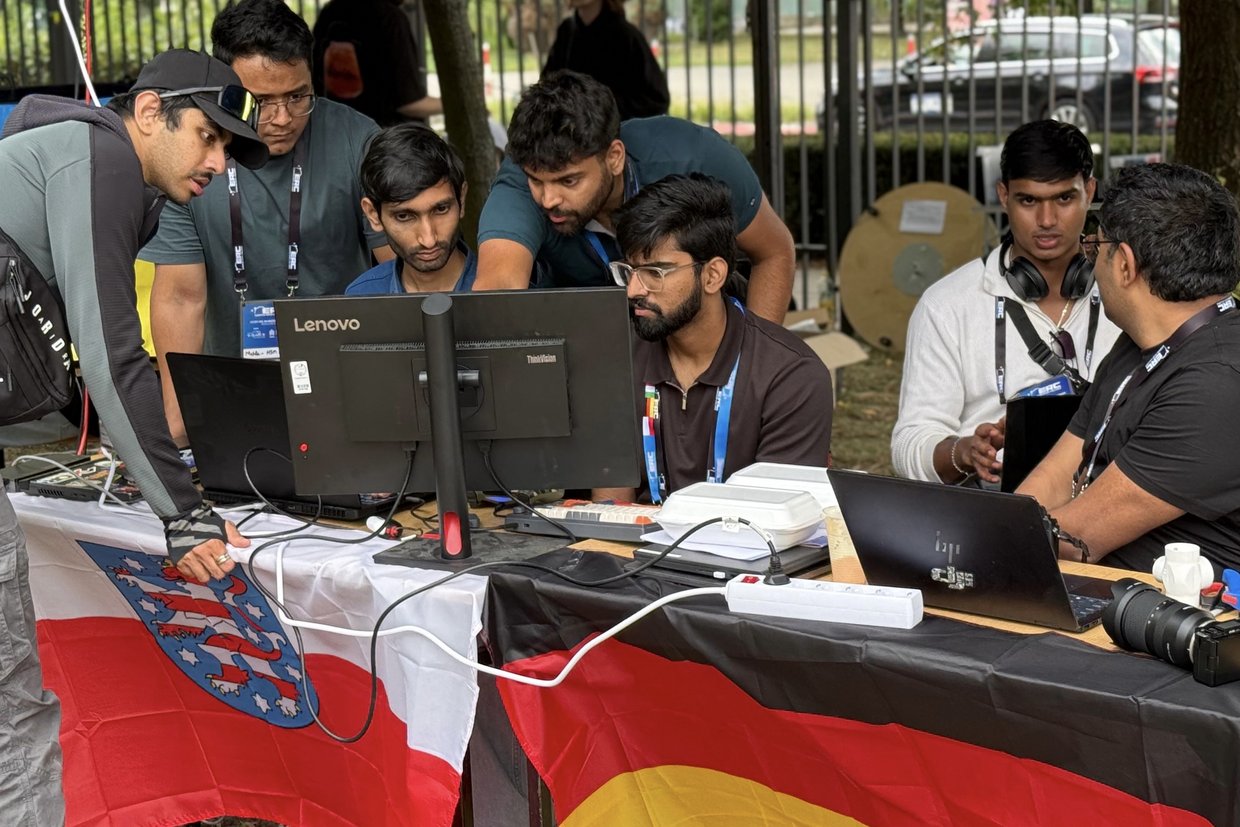
From September 3 to 6, 20 students from Schmalkalden University of Applied Sciences participated in the European Rover Challenge (ERC) in Krakow. The international competition was organized by the European Space Foundation and took place at AGH University of Krakow, a Polish partner university of Schmalkalden University of Applied Sciences. Teams from countries such as Japan, Turkey, India, Ukraine, Italy, Canada, Switzerland, and Poland gathered there with the planetary rovers they had developed themselves.
Even before the finals, HSM ARIES achieved a notable success: A total of 124 teams had registered for the European Rover Challenge, of which only 25 made it to the final round. HSM ARIES took first place in the preliminary round. In addition to Schmalkalden University of Applied Sciences, Germany was also represented in the finals by TU Dresden and Frankfurt University of Applied Sciences.
The 20 team members are studying mechatronics and robotics, electrical engineering, and computer science in bachelor’s and master’s degree programs. They spent about a year and a half developing their rover, testing various solutions, and working together to overcome numerous technical challenges. In the process, they were able to directly apply knowledge from different fields of study to real-world situations.
“A passion for space exploration and a curiosity to discover and try new things”—that’s how team leader Swaraj Tendulkar describes his motivation for the project. This enthusiasm is set to continue even after the competition in Krakow: The team plans to participate in the European Rover Challenge again next year.
In Krakow, HSM ARIES was finally able to present its rover on the international stage, gain valuable competition experience, and exchange ideas with student robotics teams from around the world. One thing is already certain for the team: The 2026 European Rover Challenge will not be their last.