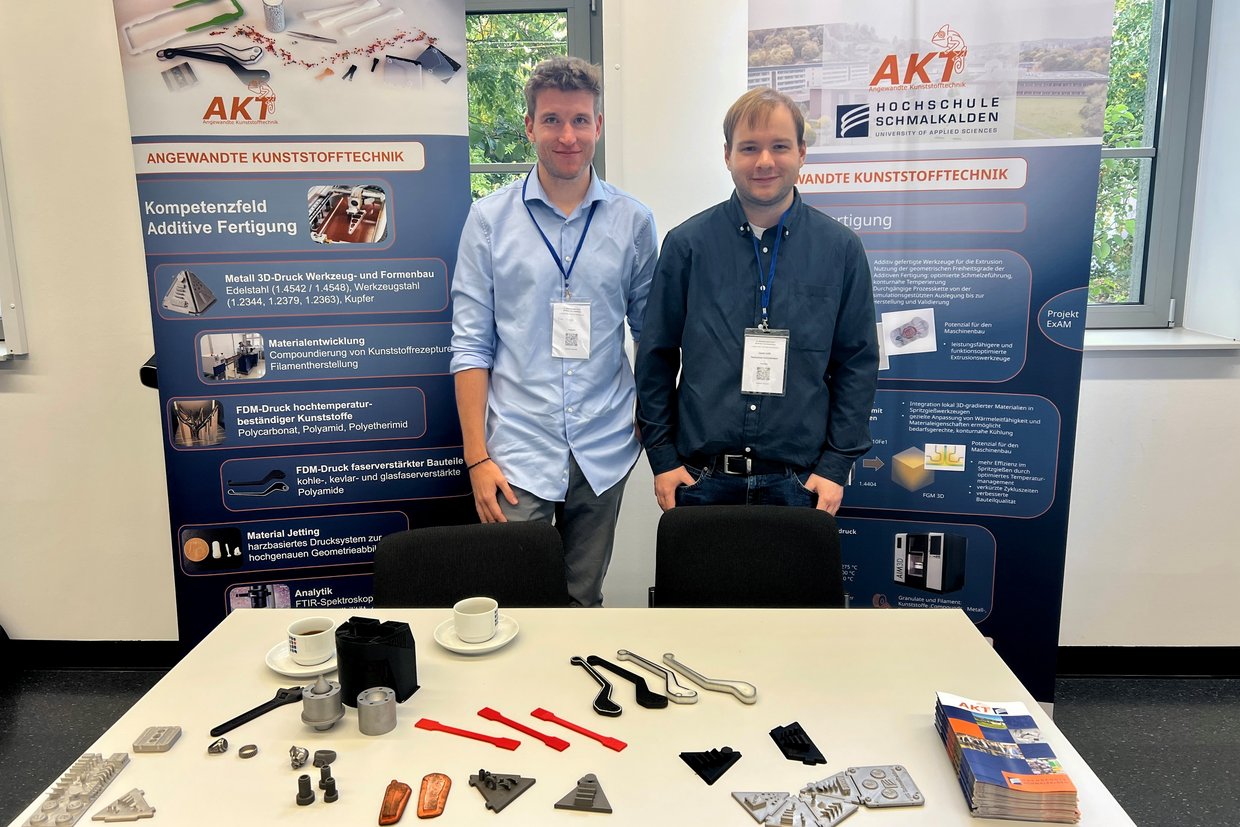
Approximately 130 participants from academia and industry gathered at the Central German Forum “3D Printing in Practice” at the Ernst Abbe University of Applied Sciences in Jena. The event provided insight into current developments in additive manufacturing and served as a platform for exchange between research and industrial practice. The Department of Applied Plastics Technology (AKT) at Schmalkalden University of Applied Sciences was also represented with its current research projects.
The focus of the AKT’s presentation was on research into the use of additive manufacturing processes in tool and mold making. Among other projects, the team presented ExAM—extrusion tools based on additive manufacturing—and FGM-Temp—the development of additively manufactured tool components made from functionally graded materials.
The ExAM project is investigating the possibilities of redesigning and manufacturing extrusion dies using additive manufacturing processes. The project focuses in particular on the structural optimization of dies and the targeted design of cooling and flow structures. Additive manufacturing opens up new design freedoms that can only be achieved to a limited extent with conventional manufacturing processes.
The FGM-Temp project takes a different approach. It investigates how functionally graded materials can be used for additively manufactured tool components. By strategically varying the material properties within a component, the project aims in particular to influence the thermal properties of tool components and to explore possibilities for optimized temperature control.
Both research projects fall under the umbrella of Industrial Collaborative Research (IGF) and are being carried out through the Research Association of German Tool and Mold Makers (FDWF). The projects thus combine scientific questions with concrete requirements from industrial practice.
At the same time, these activities highlight the profile of Applied Plastics Engineering at Schmalkalden University of Applied Sciences. The focus is on integrating plastics engineering, toolmaking, and additive manufacturing, as well as developing application-oriented solutions for modern production processes.
In addition to presenting its own research, the Central German AM Forum placed particular emphasis on professional exchange. Discussions with representatives from research and industry provided an opportunity to address current issues and gain new insights for future research and collaboration projects.
Through its participation in the forum, Schmalkalden University of Applied Sciences once again demonstrated the importance of application-oriented research as a bridge between scientific development and industrial implementation. Additive manufacturing offers great potential, particularly for toolmaking, to further develop established manufacturing concepts and enable new technical solutions.