
Applied Computer Science (M.Sc.)
A new class of IT applications emerged gaining immense attention and substantially changed the social perception of Computer Science significantly. In the same time, new challenges arose from this class of smart systems altering methods for design, development and operation of IT systems in a fundamental way.
The new challenges are deeply anchored with the main characteristics of these smart systems and applications:
- Mobility: Mobile systems are moving while providing or consuming services. Generally mobile users take mobile devices with them in order to utilize wireless communication services. Mobile Applications exhibit specific behaviors and are constrained in ways that were unknown in traditional IT systems. They have to be developed for economic use of scarce resources and at the same time to adapt gracefully to context changes.
- Distribution: Modern IT systems tend to be highly distributed. The adoption of mobile devices and wireless communication technology makes it possible to access services located globally. In consequence, the resulting complexity has to be met with adequate concepts, methods, and technologies.
- Contextual dependence: Due to mobility and rapidly changing environments applications have to adapt themselves to situational changes quickly. Smart applications are expected to deliver meaningful and adapted variants of their services in different type of environment (context awareness).
At a glance
| Study form | Full time |
|---|---|
| Study duration | 4 semester |
| Teaching language: | English |
| Graduation | Master of Science |
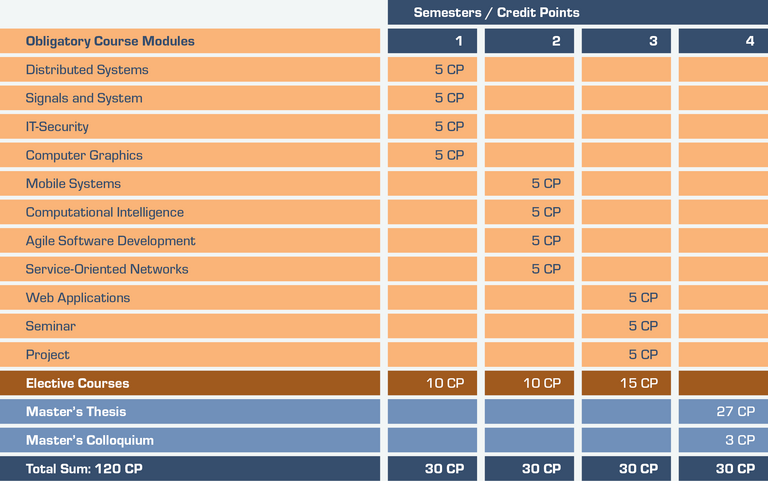
| ECTS | 120 |
| Study start | In winter term |
| Application period | 1st of February - 15th of April |
Documents for download
Brochure "Applied Computer Science"
Module description "Applied Computer Science (M.Sc.)"
Modulhandbuch "Applied Computer Science (M.Sc.)"
Study regulations | 18.03.2025
Study regulations | 22.12.2022
Study regulations | 22.06.2022
Study regulations | 05.11.2019
Study regulations | 12.12.2018
Study regulations | 11.01.2018
Examination Regulations | 18.03.2025
Examination Regulations | 22.12.2022
Examination Regulations | 19.01.2022
Examination Regulations | 24.03.2020
Examination Regulations | 14.11.2018
- An outstanding academic degree in the fields of informatics or related areas (Bachelor degree, German "Diplom"), or equivalent which should have in general a grade better than 2.5.
- Proof of English language ability: TOEFL IBT 86 or better, or IELTS 6.5 or better. Medium of instruction during undergraduate studies is not sufficient for admission. English native speakers are exempt from this.
To apply please fill out the following application form:
All required documents:
- Your curriculum vitae
- Letter of motivation that states the study interest and proves practical skills in the field of software development, advanced knowledge in an object-oriented programming language (e.g. Java) as well as the obvious interest in topical questions of modern software development (max. 1 page)
- A copy of your birth certificate or a copy of your passport or identity card
- A copy of the university entrance qualification (highest school leaving certificate)
- Officially notarized copy (copies) of your university degree(s) and certified translation(s) into English or German
- One passport photo (will be requested in a later step)
- English language certificate as outlined above.
Please note that applicants with degrees from India, Vietnam and China must also enclose a valid APS certificate with their application. Be sure to apply for your APS certificate in your home country in good time.
- Distributed and Mobile Systems. Central Topics include: Concepts and methods for the development of distributed and mobile systems, Software engineering, programming of mobile applications and communication technologies, Advanced concepts for the engineering of distributed systems as well as modern integration technologies and middleware platforms.
- Knowledge Engineering and Data Science. For knowledge engineering and data science the autonomous interactions to several kinds of environments providing data is of basic importance. The courses provides build up a deep knowledge, from basic to advanced topics as well as practical abilities in data acquisition, digital signal processing with emphasis on time series processing and prediction, feature extraction methodologies and machine learning technologies.
- Software Engineering. Central Topics include: Interdisciplinary and holistic techniques for the development of smart systems. This affects design, development, testing, and operation of these applications.
- Communication Technologies and Security: Distributed and mobile systems are highly communication intensive. A solid knowledge of underlying communication technologies is a prerequisite for the development of these systems and their security.
Career prospects
Career Paths after Graduation
A Master's degree in Applied Computer Science (M.Sc.) at Hochschule Schmalkalden provides the foundation for a successful career in advanced specialist roles and strategic leadership positions within the global tech industry. Depending on the chosen specializations and elective courses, a wide range of high-level professional fields are open to you. Typical positions for our Master's graduates include:
| Field of Expertise | Typical Job Titles |
|---|---|
| Software Architecture & Engineering | Senior Software Architect • Lead Software Engineer • Cloud Solutions Architect |
| Data Science & Artificial Intelligence | Senior Data Scientist • Machine Learning / AI Engineer • Big Data Architect |
| Cyber Security & Infrastructure | IT Security Architect • DevSecOps Engineer • Senior Infrastructure Engineer |
| IT Management & Consulting | Technical Product Owner • IT Strategy Consultant • R&D Project Manager |
Industries and Top Employers (Selection)
Our alumni data from LinkedIn shows that graduates (M.Sc.) are exceptionally well-equipped to drive technological innovation and lead complex software projects – joining cutting-edge software companies, research-oriented industries, and global technology corporations.
- Software, Cloud & IT Consulting: IBM, SAP, Microsoft, adesso, Intershop (Jena), dotSource (Jena), as well as international IT service providers and consulting firms.
- High-Tech, Photonics & Advanced Manufacturing: Carl Zeiss (Jena), Jenoptik (Jena), Bosch (Eisenach), and research-focused technology corporations implementing Industry 4.0 solutions.
- Digital Economy & E-Commerce: Amazon, Zalando, as well as agile international tech scale-ups and platforms.
- Research Institutes & Public Infrastructure: Fraunhofer Institutes, state computing centers (such as TLRZ), and major financial IT providers (e.g., Finanz Informatik).

Sebastian, 22 Jahre, Dermbach, Studiengang: Applied Computer Science
"Studying at University of Applied Sciences Schmalkalden is pleasant and varied. In addition to theoretical content, there is a wide range of practical relevance."